Top 7 Ruby on Rails CMS Platforms of 2026
A clear overview of Ruby on Rails CMS platforms in 2026. Understand how to evaluate and choose the right option for your Rails application.


Pichandal
Technical Content Writer


Choosing a Ruby on Rails CMS in 2026 is less about popularity and more about architectural fit. Modern Rails CMS platforms must support Rails 7 and 8, integrate cleanly with existing applications, and offer intuitive editorial workflows.
This article compares seven Rails-native CMS platforms based on real-world usage, flexibility, scalability, and long-term maintainability.
What Is a CMS?
A Content Management System (CMS) is software that allows teams to create, manage, and publish digital content without modifying application code.
In a Ruby on Rails context, a CMS typically integrates directly into a Rails application or operates as a headless service that delivers content via APIs.
How to Evaluate Ruby on Rails CMS Platforms
Evaluating a Ruby on Rails CMS in 2026 requires looking beyond surface-level features. The most reliable platforms align with modern Rails conventions, support evolving content models, and remain maintainable as applications scale.
The criteria used in the comparison must focus on:
-
Compatibility with recent Rails versions, including Rails 7 and emerging Rails 8 patterns
-
Support for structured or component-based content
-
Flexibility across monolithic, headless, or hybrid architectures
-
Editorial usability for non-technical content teams
-
Ongoing maintenance, security practices, and community activity
In simple words, a strong Rails CMS balances developer flexibility, editorial usability, and long-term compatibility with the Rails ecosystem.
1. Alchemy CMS
What makes Alchemy CMS a strong choice for large Rails applications?
Alchemy CMS is a Rails engine designed for teams managing structured content at scale. It separates content modeling and editorial workflows from presentation logic, allowing developers and content teams to work independently within the same Rails application.
Alchemy is commonly used for projects where content is assembled from reusable components rather than static pages. Developers define content structures in code, while editors manage content through a controlled admin interface, reducing coupling as content complexity grows.
Features
-
Component-based page building for editors
-
Role-based access for content teams
-
Visual admin interface for managing structured content
Core capabilities
-
Rails Active Storage–based media handling
-
Multi-site and multi-language support
-
Rails-native security and caching mechanisms
Best suited for
-
Large marketing or corporate websites
-
Organizations managing multiple brands or regions
-
Teams with distinct developer and editorial roles
Quick takeaway:
Alchemy CMS fits large Rails applications that require structured content, centralized governance, and long-term maintainability.
2. Refinery CMS
Why is Refinery CMS still widely used in Rails projects in 2026?
Refinery CMS is one of the longest-running content management systems in the Rails ecosystem. It follows conventional Rails patterns and is designed to be added incrementally to existing applications rather than replacing them entirely.
Refinery is often selected for projects that value stability and simplicity over highly customized content models. Its modular design allows teams to enable only the features they need, keeping the overall application footprint manageable.
Features
-
User-friendly admin interface for non-technical editors
-
Modular extensions for images, pages, and SEO
-
Built-in internationalization support
Core capabilities
-
Engine-based architecture following the “Rails Way”
-
Support for over 30 languages out of the box
-
Active community maintenance and documentation
Best suited for
-
Small to mid-sized business websites
-
Rails applications adding CMS functionality gradually
-
Teams prioritizing long-term stability
Quick takeaway:
Refinery CMS is a reliable option for Rails teams that want a conventional, community-backed CMS with minimal architectural overhead.
3. Fae CMS
When does Fae CMS make more sense than a page-based CMS?
Fae CMS is designed around managing structured objects rather than traditional pages. Instead of focusing on page hierarchies, it provides tools for building custom admin interfaces tailored to application-specific data models.
In 2026, Fae is commonly used alongside decoupled front ends or GraphQL APIs. Its approach allows developers to scaffold admin functionality quickly while retaining full control over business logic and presentation.
Features
-
Customizable admin UI for complex data models
-
Global search and content change tracking
-
Image processing and asset management
Core capabilities
-
Inheritance-based CRUD scaffolding
-
GraphQL-friendly workflows
-
Tight integration with standard Rails models
Best suited for
-
Data-heavy applications with complex Rails models
-
Projects requiring custom CRUD interfaces for large datasets
-
Teams managing structured content such as directories, catalogs, or registries
Quick takeaway:
Fae CMS works best when content behaves like application data rather than editable pages.
4. Spina CMS
Is Spina CMS a good fit for SEO-focused Rails websites?
Spina CMS is a minimalist Rails CMS focused on editor usability and clean design. It avoids complex configuration in favor of predefined patterns that allow content teams to work without understanding HTML or CSS.
Spina is frequently chosen for marketing sites and startup landing pages where speed, SEO readiness, and a modern admin experience matter more than deep customization.
Features
-
Drag-and-drop content blocks
-
Built-in meta tags and URL redirects
-
Mobile-friendly admin interface
Core capabilities
-
Optimized for modern Rails caching strategies
-
Native support for fragment caching and Solid Cache
-
Rails 7 and Rails 8 compatibility
Best suited for
-
SEO-driven marketing websites
-
Startups and design-focused teams
-
Projects requiring fast setup and deployment
Quick takeaway:
Spina CMS is ideal for teams that want a lightweight, editor-friendly Rails CMS with strong SEO fundamentals.
5. Locomotive CMS
Why is Locomotive CMS popular for multisite management?
Locomotive CMS is built for managing multiple websites from a single Rails-based system. Its architecture separates the CMS engine from site development, allowing teams to build and preview sites locally before deployment.
Locomotive is commonly used by organizations running multi-brand or multi-region portfolios. Its templating system limits direct server access, which improves safety in shared or multi-tenant environments.
Features
-
Local development and preview via CLI tooling
-
Liquid-based templating for secure theming
-
Optional managed cloud hosting
Core capabilities
-
Multi-site architecture
-
Support for large traffic volumes
-
Open-source and hosted deployment options
Best suited for
-
Multi-brand or multi-region websites
-
Teams needing controlled deployment workflows
-
Organizations managing multiple sites at scale
Quick takeaway:
Locomotive CMS is well suited for Rails teams managing multiple websites from a single, scalable CMS instance.
6. Camaleon CMS
Is Camaleon CMS a practical alternative to WordPress on Rails?
Camaleon CMS follows a plugin-based model similar to WordPress but is built natively on Rails. It allows administrators to define content structures through the admin interface without writing code.
Camaleon is often chosen by teams migrating from PHP-based CMS platforms. Its familiarity reduces onboarding time while still benefiting from Rails’ security and performance characteristics.
Features
-
Plugin-based extensibility
-
No-code content type creation
-
Built-in eCommerce support for simple stores
Core capabilities
-
Semantic content grouping
-
Hardened security protections
-
Theme-driven rendering system
Best suited for
-
Editorial or publishing-heavy websites
-
Teams transitioning from WordPress
-
Projects requiring frequent content structure changes
Quick takeaway:
Camaleon CMS fits teams that want WordPress-like flexibility while staying within the Rails ecosystem.
7. ComfortableMexicanSofa (CMSofa)
When should you use ComfortableMexicanSofa instead of a full CMS?
ComfortableMexicanSofa is a lightweight CMS engine designed to be mounted inside an existing Rails application. It does not impose front-end constraints, allowing developers to retain full control over views and routing.
It is commonly used in SaaS products and internal tools where content management is necessary but not the primary function of the application.
Features
-
Mountable CMS engine
-
Flexible content mirroring across locales
-
Developer-controlled rendering
Core capabilities
-
Minimal assumptions about front-end structure
-
Multi-site and multi-language support
-
Rails-native integration
Best suited for
-
SaaS products and internal tools
-
Applications needing embedded content management
-
Teams prioritizing flexibility over templates
Quick takeaway:
ComfortableMexicanSofa is ideal when content management must adapt to an existing Rails application, not replace it.
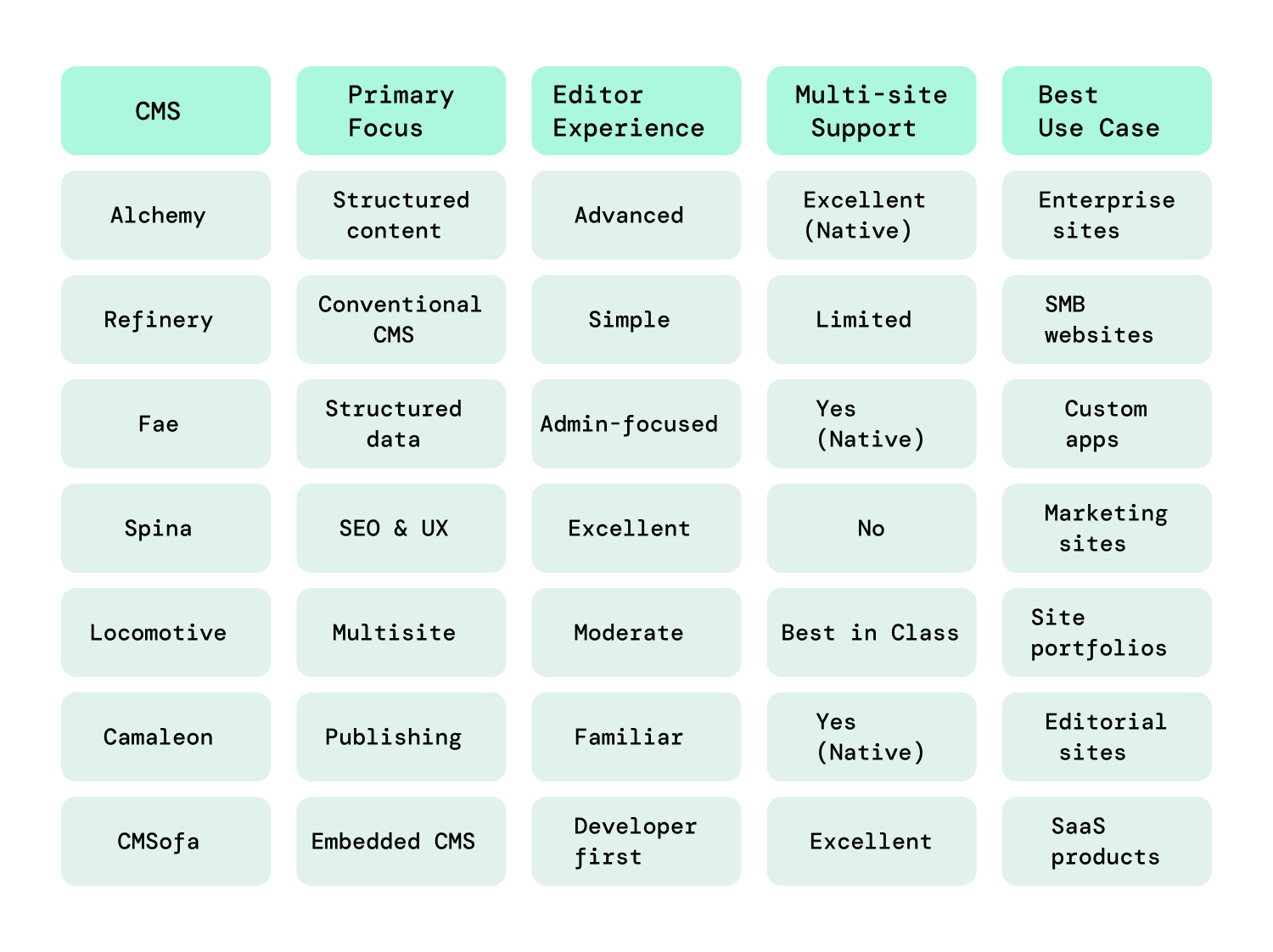
Comparison: Ruby on Rails CMS Platforms in 2026
Conclusion
The Ruby on Rails CMS ecosystem in 2026 is defined by specialization, not overlap. Each platform solves a different problem, whether it’s structured content at scale, complex data management, performance-focused marketing sites, or embedded CMS needs inside SaaS products.
Security remains a strong advantage of Rails-based CMS platforms. Built on Rails’ mature security defaults and supported by active maintenance, these CMS options offer a solid foundation for applications where content and business logic are closely intertwined.
Choosing the right Rails CMS ultimately comes down to selecting the platform that best aligns with your application’s content model, security expectations, and long-term maintainability goals.
Besides, selecting the right CMS is only part of the equation. Many organizations choose to hire Rails developers with CMS implementation experience to ensure clean integration, long-term maintainability, and Rails upgrade readiness.
If you’re looking for the right Ruby on Rails partner to assess your current needs, RailsFactory can help. We work with teams to evaluate CMS requirements, recommend the right Rails-based solution, and build scalable systems that grow with your product. Reach out to RailsFactory team to get started.