


Active Record
ActiveRecord is the Object-Relational Mapping (ORM) framework in Ruby on Rails that connects your Ruby objects to the database. It allows you to interact with database tables using Ruby code instead of writing raw SQL.
Table of Contents
What is ActiveRecord in Ruby on Rails?
ActiveRecord is the part of Rails that handles database interactions. Each database table is represented as a Ruby class, and each row in that table is represented as an object of that class. This allows developers to create, read, update, and delete data using Ruby syntax rather than SQL queries.
In short, ActiveRecord is what lets Rails apps talk to the database in a Ruby-friendly way.
Why is ActiveRecord Useful?
Without ActiveRecord, developers would have to write raw SQL queries for every database operation, which can be:
-
Time-consuming
-
Error-prone
-
Hard to maintain
ActiveRecord provides:
-
An intuitive, Ruby-style way to interact with databases.
-
Automatic mapping between database tables and Ruby objects.
-
Built-in validations and callbacks for data integrity.
-
Scopes and query methods for easy data retrieval.
-
Easy relationships between tables (associations like has_many and belongs_to).
How ActiveRecord Works?
ActiveRecord uses classes and objects to represent tables and rows.
Key components:
-
Models: Represent database tables (e.g.,User, Post).
-
Migrations: Define or modify the structure of database tables.
-
Associations: Define relationships between tables (has_many, belongs_to).
-
Validations: Ensure data meets certain criteria before saving.
-
Query Interface: Methods like where, find, order to fetch data.
Example
Scenario: A blog app with posts.
Model (post.rb):
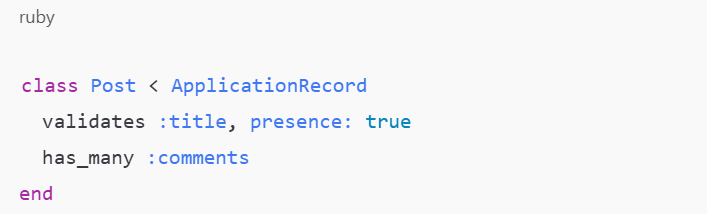
Creating a new post:

Querying posts:

Associations:
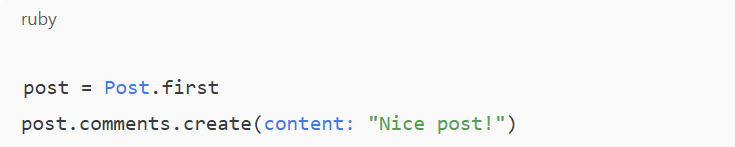
These examples show how ActiveRecord lets you define models, create records, query data, and handle associations in a simple, Ruby-friendly way.
Where to Use ActiveRecord?
-
Managing users, products, orders, or any database-backed resources.
-
Handling relationships between entities (e.g., posts & comments, orders & items).
-
Validating data before saving to the database.
-
Writing queries without raw SQL.
-
Building dashboards, admin panels, or reports that need database interaction.
In Summary
ActiveRecord is the database bridge in Ruby on Rails. It lets developers interact with tables and rows as Ruby objects, handle validations, and define relationships in an intuitive, readable way. It simplifies database operations, reduces errors, and keeps Rails applications organized.