


Minitest
Minitest is the default testing framework bundled with Ruby on Rails. It provides a simple, fast, and lightweight way to write unit, integration, and system tests using Ruby’s built-in testing tools.
Table of Contents
What is Minitest in Ruby on Rails?
Minitest is the testing framework that comes preconfigured with Rails applications. It allows developers to write automated tests to ensure that their application code behaves as expected.
Rails uses Minitest to test models, controllers, helpers, mailers, jobs, and full application flows. Tests are written in plain Ruby, making them easy to read, write, and maintain.
In short, Minitest helps Rails developers verify that their application works correctly and continues to work as it evolves.
Why is Minitest Useful?
Without automated testing, bugs can slip into production, and changes can unintentionally break existing functionality.
Minitest is useful because it:
-
Comes bundled with Rails (no extra setup required)
-
Has a simple and readable syntax
-
Runs fast, even for large test suites
-
Integrates seamlessly with Rails features
-
Supports multiple test types (unit, integration, system)
It encourages test-driven development and helps teams catch issues early in the development cycle.
How Minitest Works?
Minitest is based on Ruby classes and assertions.
Key components:
-
Test Cases: Classes that define tests (e.g., UserTest)
-
Assertions: Methods that check expected behavior (assert, assert_equal)
-
Fixtures: Sample data for testing
-
Setup & Teardown: Prepare data before tests run
-
Rails Test Helpers: Utilities for testing controllers, jobs, and views
Example
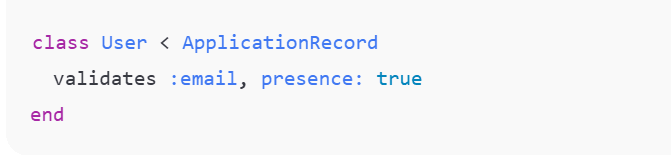
Scenario: Testing a User model and controller in a Rails application.
User model (user.rb)
Model test (test/models/user_test.rb)
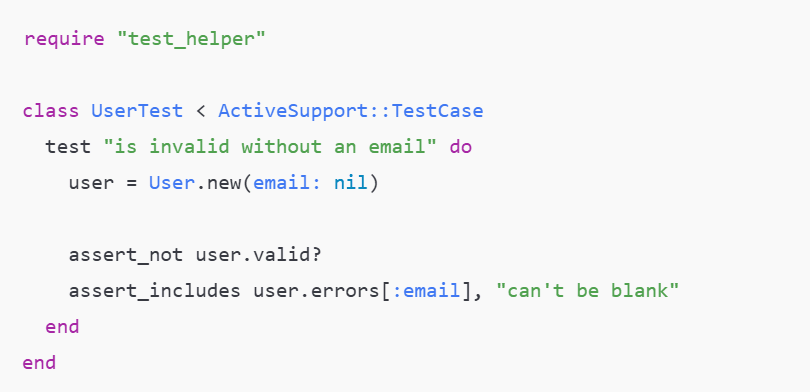 This test ensures that a user record cannot be saved without an email address.
Controller test (test/controllers/users_controller_test.rb)
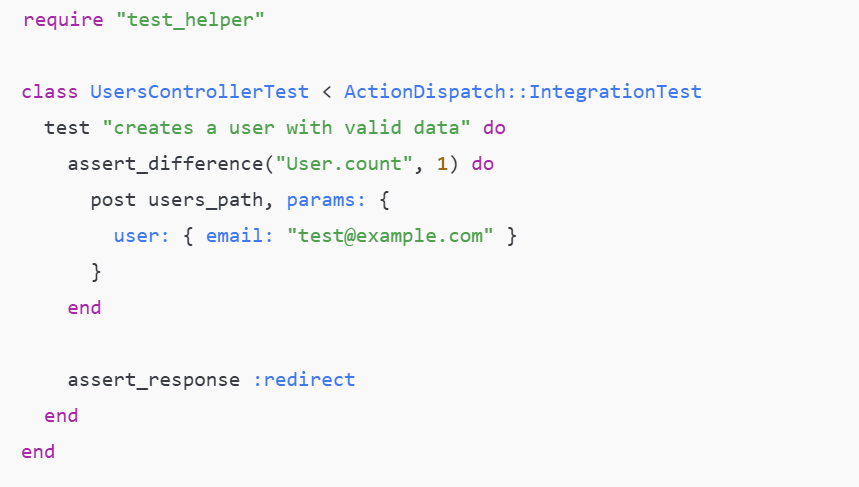 This test verifies that a user is successfully created when valid parameters are provided.
Running the tests
 Rails runs all Minitest files and reports passing tests, failures, and errors.
These examples show how Minitest is used to validate models, test controller behavior, and ensure application logic works as expected.
Where to Use Minitest?
-
Model testing – Verify validations, associations, and business logic
-
Controller testing – Ensure requests, responses, redirects, and status codes behave correctly
-
Integration testing – Test how multiple parts of the application work together
-
System testing – Simulate real user interactions like form submissions and navigation
-
Regression testing – Catch bugs when refactoring or adding new features
-
Pre-deployment testing – Ensure the application is stable before releasing changes
In Summary
Minitest is the built-in testing framework for Ruby on Rails that helps developers write fast, reliable, and readable tests. By integrating tightly with Rails and using simple Ruby syntax, it ensures application quality while keeping the testing process lightweight and maintainable.