From Automation to Intelligent Automation: How Python Bots Start Making Decisions
Explore how Python enables intelligent automation with AI, machine learning, and NLP to handle variable inputs, support decisions, and automate workflows.


Sandhya K
Junior Software Developer


Automation has become an important part of modern software development. It helps organizations reduce repetitive manual work, improve consistency, and save time. Python is widely used for automation because of its simple syntax and large ecosystem of libraries for APIs, web automation, data processing, AI, and Machine Learning.
However, traditional automation has a limitation: it generally follows predefined instructions.
When the inputs and business rules are predictable, this works well. But real-world processes are not always predictable. Data may be incomplete, formats may change, and some situations may require interpretation before deciding what action to take.
This is where Intelligent Automation comes into the picture.
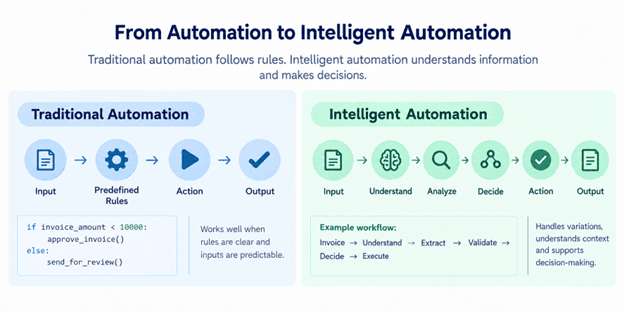
Traditional automation follows predefined rules, while Intelligent Automation combines automation with AI-based capabilities to understand information and support decision-making
What is Intelligent Automation?
A traditional automation workflow can be represented as:
Input → Predefined Rules → Action → Output
For example:
if invoice_amount < 10000:

    approve_invoice()

else:

    send_for_review()
The system follows a fixed rule.
Intelligent Automation adds an additional layer of understanding:
Input → Understand → Analyze → Decide → Action → Output
For example, instead of only checking whether an invoice follows a specific format, an intelligent system could extract information from different invoice formats, validate the data, identify unusual values, and determine whether the invoice can be processed automatically.
The key difference is the ability to handle more variation and make decisions using additional context.
Traditional Automation vs Intelligent Automation
Traditional automation is mainly rule-based.
It works well when:
-
Inputs are predictable.
-
Business rules are clearly defined.
-
Data is structured.
-
The process is repetitive.
-
Exceptions are limited.
For example, an email automation might check:
if "invoice" in email.subject.lower():
process_invoice(email)
This works when users consistently use the word "invoice." But they might instead write "Payment Document" or "Please process this bill."
The intent could be the same even though the wording is different.
An intelligent automation system can use Natural Language Processing (NLP) or AI to understand the intent rather than relying only on exact keywords.
The workflow becomes:
Email → Understand Intent → Extract Information → Validate → Decide → Execute
Technologies Behind Intelligent Automation
Intelligent Automation is not a single technology. It combines automation with different AI-based technologies depending on the problem.
Artificial Intelligence
AI enables systems to perform tasks that normally require human intelligence, such as classification, reasoning, and decision-making.
Machine Learning
Machine Learning allows systems to identify patterns from data and use those patterns to make predictions or classifications.
Natural Language Processing
NLP helps systems understand human language.
For example:
"Please process PO 59674-175 for 20 units."
A system could extract:
PO Number: 59674-175 | Quantity: 20
Computer Vision
Computer Vision allows systems to understand images and documents. It can be used to extract information from invoices, receipts, scanned forms, and other documents.
Generative AI
Generative AI can help automation systems understand unstructured information, summarize content, generate responses, and interact with users using natural language.
The Role of Python
Python is particularly useful for Intelligent Automation because it can connect different systems and technologies.
Python can be used for:
-
API integration
-
Web automation
-
Data processing
-
Database operations
-
Email automation
-
Machine Learning
-
AI integration
-
File processing
A simple workflow could be:
Receive Input → Process Data → Apply Intelligence → Make Decision → Perform Action
For example:
data = extract_information(email)

if validate(data):

    process_order(data)

else:

   send_for_human_review(data)
The code may be simple, but it can form part of a much larger automated workflow.
Intelligent Automation with Human-in-the-Loop
Intelligent Automation does not necessarily mean removing humans completely.
For many business processes, a better approach is to combine automation with human judgment.
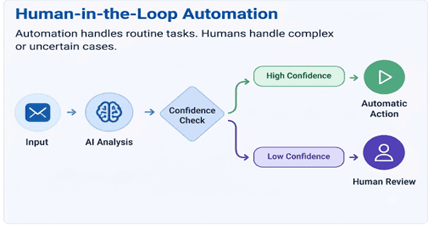
A typical workflow is:
Input → AI Analysis → Confidence Check → Automatic Action OR Human Review
For example, if an AI system is highly confident about information extracted from an invoice, it can process the invoice automatically.
If the information is uncertain, it can send the invoice to a human for verification.
This approach is known as Human-in-the-Loop (HITL) automation.
The goal is not to automate every decision. Instead, automation should handle reliable and repetitive decisions while humans handle situations that require additional judgment.
Building Reliable Intelligent Automation
Adding AI does not automatically make an automation system reliable.
Good software engineering practices are still essential.
Important considerations include:
Error Handling
External APIs, databases, and web applications can fail. The automation should identify failures and respond appropriately.
Retry Mechanisms
Temporary failures can sometimes be handled through retries.
Task → Failure → Check Failure → Retry OR Escalate
Idempotency
Idempotency helps prevent duplicate actions when an operation is retried.
For example:
if order_already_processed(order_id):

    return process_order(order_id)
The system checks the current state before performing the operation.
Logging and Monitoring
A production automation system should record what happened, when it happened, and why an operation succeeded or failed.
Intelligent Automation vs Hyperautomation
Since Intelligent Automation is closely related to Hyperautomation, it is important to understand the difference.
Hyperautomation is a broader approach to automating business processes by combining technologies such as:
RPA + APIs + Workflow Automation + AI + Process Mining + System Integration
Its focus is on automating processes end-to-end.
Intelligent Automation focuses on adding intelligence to those automated workflows:
Automation + AI + ML + NLP + Computer Vision + Generative AI
A simple way to remember the difference is:
Hyperautomation asks: "How much of this process can we automate?"
Intelligent Automation asks: "How can we make the automation understand and handle decisions?"
The two approaches can work together.
When Should We Use Intelligent Automation?
Not every automation problem needs AI.
Traditional automation is often enough when the rules are simple, inputs are structured, and the workflow is predictable.
Intelligent Automation becomes more useful when:
-
Data is unstructured.
-
Inputs vary significantly.
-
Natural language is involved.
-
Classification is required.
-
Pattern recognition is required.
-
There are many exceptions.
-
Human decision-making is slowing down the process.
A good automation engineer should always ask:
Does this problem actually require intelligence?
If a simple Python rule can solve the problem reliably, adding AI may only increase complexity and cost.
The Future of Python Automation
The evolution of automation can be viewed as:
Manual Process → Rule-Based Automation → Intelligent Automation → Agentic Automation
Traditional automation executes predefined instructions.
Intelligent Automation adds the ability to understand information, identify patterns, and support decisions.
The next evolution is Agentic Automation, where AI-based systems can be given a goal and determine the steps required to achieve it.
This creates new possibilities for Python developers to build systems that can understand, decide, act, and recover, rather than simply execute a fixed sequence of instructions.
Conclusion
Automation started with a simple idea: let machines perform repetitive tasks.
Intelligent Automation takes this idea further by combining traditional automation with AI technologies that allow systems to understand information and support decision-making.
Python plays an important role because it provides tools for connecting APIs, databases, web applications, AI models, and automation workflows.
However, Intelligent Automation is not simply about adding AI to a Python script. A reliable solution combines:
Automation + AI + Business Rules + Validation + Error Handling + Monitoring + Human Oversight
The goal is not to automate everything blindly. It is to build systems that can automate predictable tasks, intelligently handle variations, and involve humans when human judgment is needed.