Music App Monetization: Subscription Models, Royalties, and Revenue Architecture
Learn how music apps make money, how streaming royalties work, and which monetization strategies can help build a sustainable music platform.


Pichandal
Technical Content Writer


Music app monetization strategies in 2026 come down to three moving parts: how you charge listeners, how you pay rights holders, and how those two systems connect without losing money in between.
Get the connection wrong, and growth doesn't translate into revenue for the platform or the artist. The most effective music app monetization strategies balance user acquisition, recurring revenue, royalty obligations, and long-term retention rather than optimizing for revenue alone.
If you've ever looked at a streaming payout statement and wondered how 50,000 plays resulted in such a tiny payment, you already know the problem. This isn't a niche complaint. It's the defining tension of the streaming era, and it shapes every decision a music app makes, from pricing tiers to royalty splits.
This article breaks down the subscription models music apps use, how royalties are calculated behind the scenes, which platforms pay artists the most, and how to think about revenue architecture if you're building a music streaming app or evaluating a platform yourself.
Why Is Music App Monetization So Complicated?
Music monetization involves more stakeholders than almost any other content category. A single stream can trigger payments to the artist, the label, the songwriter, the publisher, and sometimes a producer or featured performer, each governed by separate licensing agreements.
On top of that, licensing itself splits into different royalty types:
- Mechanical royalties - paid for reproducing a composition
- Performance royalties - paid when a song is performed or streamed publicly
- Sync royalties - paid when music is paired with visual media, like a video or ad
A music app has to account for all of this before it earns a cent of margin. That's why per-stream payouts look so small: platforms are splitting one pool of subscription and ad revenue across millions of songs and several layers of rights holders simultaneously.
This complexity is why music app monetization strategies cannot be evaluated by looking at subscription prices alone. A platform also needs to consider licensing costs, payment processing, customer acquisition, infrastructure, and the cost of retaining both listeners and creators.
What Subscription Models Do Music Apps Actually Use?
Most music apps rely on some combination of the following models, often layered together rather than used in isolation. Choosing how these models work together is one of the most important music app monetization strategies for a new platform.
Ad-supported free tier - Listeners get access without paying, and the app earns ad revenue instead. This drives reach and top-of-funnel growth, but ad-tier streams pay artists a fraction of what subscriber streams pay, often two to three times less.
Freemium subscription- The standard model for mass-market apps: a free ad-supported tier funnels users toward a paid tier with no ads, offline listening, and higher audio quality. This is the backbone of Spotify, Apple Music, and most major platforms.
Family and bundle plans- Multi-user pricing increases household retention and lowers per-user churn, even though the per-account revenue drops. Family plans can be particularly effective as a retention-focused music app monetization strategy because users are less likely to cancel when multiple members of a household depend on the same subscription.
Tiered subscriptions- Higher tiers unlock lossless or spatial audio, exclusive releases, or early access. This works well for platforms targeting audiophiles or superfans willing to pay a premium.
Direct-to-fan subscription- Rather than routing revenue through a label or aggregator, some platforms let fans pay artists directly for exclusive content, early releases, or memberships, closer to a Patreon model than a traditional streaming app. This is one of the more emerging music app monetization strategies, particularly for platforms focused on independent artists and niche communities.
The right model depends heavily on your audience. A platform built for casual listening needs the ad-supported funnel. A platform built around a subscription platform for music artists, where the artist relationship is the product, usually skips the free tier entirely and goes straight to direct-pay memberships.
In practice, the strongest music app monetization strategies often combine multiple models. A platform might use advertising to acquire users, subscriptions to generate predictable recurring revenue, and direct-to-fan features to create additional high-margin revenue opportunities.
How Do Music Royalties Actually Work?
Most streaming platforms use a pro-rata model: all subscription and ad revenue for the month gets pooled together, then divided based on each track's share of total streams platform-wide. If your song made up 0.001% of total streams that month, you get 0.001% of the royalty pool.
This is different from a user-centric model, where your subscription fee is distributed only among the artists you personally listened to, rather than mixed into one giant global pool.
The reason per-stream numbers vary so widely between articles and calculators is that they're averages, shaped by:
- The listener's country
- Whether the stream came from a free or paid account
- The platform's overall revenue that month
- Label and distribution deal terms
This is also why two artists with identical stream counts can end up with very different payouts.
Here's a relatable way to picture it:
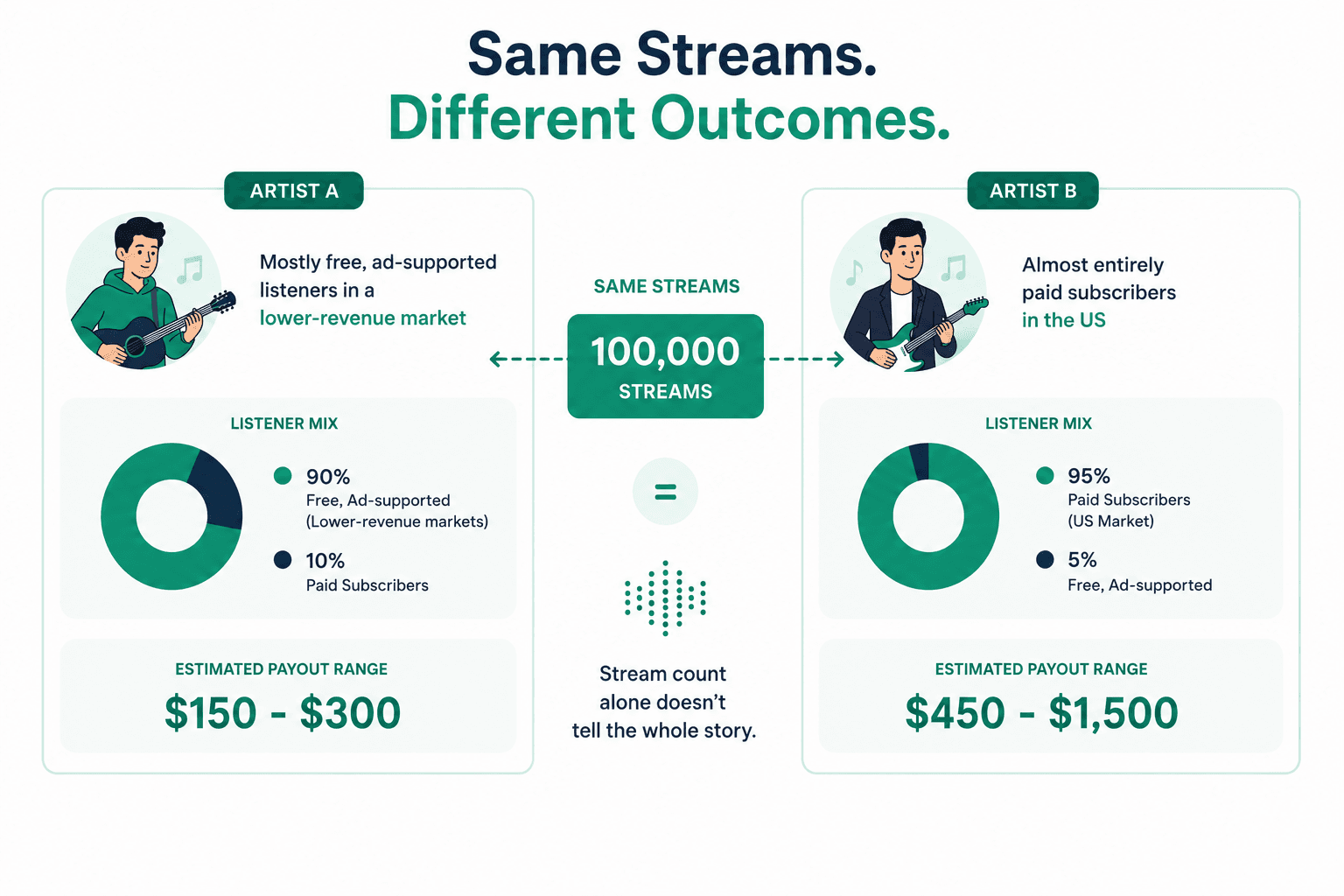
This is also why royalty statements can feel confusing to read. A single stream doesn't map to a single flat payment; it maps to a fractional share of a monthly pool, recalculated every cycle based on total platform activity.
If artists can't understand how their earnings are calculated, they may be less likely to stay on a platform, regardless of how attractive its subscription model is. That makes transparent royalty systems an important part of effective music app monetization strategies.
For independent artists managing their own distribution, understanding this mechanic is often more useful than chasing any one platform's advertised rate.
What Streaming Service Pays Artists the Most in 2026?
This is the question most artists actually want answered, and the honest answer is: it depends whether you're optimizing for rate or reach.
Subscription-only platforms with no free tier tend to pay the highest per-stream rates, because every stream comes from a paying listener rather than an ad-supported one. Here's how the major platforms compare on a per-stream basis:
| Platform | Est. Pay Per Stream (2026) | Free Tier? |
|---|---|---|
| Qobuz | $0.015 – $0.019 | No |
| Tidal | $0.012 – $0.015 | No |
| Apple Music | $0.006 – $0.010 | No |
| Deezer | $0.005 – $0.007 | Yes |
| Amazon Music | ~$0.004 | Limited |
| Spotify | $0.003 – $0.005 | Yes |
| YouTube Music | $0.001 – $0.002 | Yes |
Rates are blended averages and will shift with each platform's monthly revenue, subscriber mix, and listener geography.
By pure rate, Tidal and Apple Music consistently outperform Spotify, often paying two to three times more per play. That makes them strong contenders for the best music streaming service for artists on a per-stream basis.
But rate isn't the whole story. Spotify's much larger user base means many independent artists still generate more total revenue there than on smaller, higher-paying platforms, simply because of volume. An artist chasing the platform that pays the most per stream can end up worse off than one who stays where the audience already is.
The practical takeaway: don't pick one platform. Distribute broadly, and treat per-stream rate as one input, not the whole strategy.
Are New Subscription Platforms Better for Artists Than Traditional Streaming?
A growing number of platforms are built specifically as a subscription platform for music artists rather than general-purpose streaming apps. Instead of routing revenue through a pooled royalty system, these platforms let artists monetize directly through:
- Paid subscriber memberships
- Exclusive or early-access content
- Fan tipping and pay-what-you-want drops
- Direct merchandise and ticket bundling
The appeal is straightforward.
An artist keeps a much larger share of revenue and has direct visibility into who's paying and why, instead of waiting on an opaque monthly royalty statement. The tradeoff is discovery. These platforms depend on an artist already having an audience, since they don't offer the algorithmic reach of a major streaming service.
For most working artists, the realistic strategy is layering both: streaming platforms for discovery and reach, direct-to-fan platforms for actual margin.
How Should You Architect Revenue If You're Building a Music App?
If you're building or evaluating a music platform rather than just distributing music on one, monetization needs to be designed, not bolted after launch.
This is where music app monetization strategies need to be considered alongside product architecture, licensing, user experience, and payment infrastructure from the beginning.
A few principles worth building around:
Layer your revenue streams - Combine subscriptions, ad revenue, and optional microtransactions (tipping, exclusive content) rather than relying on one channel. A single revenue source leaves you exposed if that channel underperforms or if licensing terms change.
Build payout transparency in from day one - Artists increasingly choose platforms based on how clearly royalties are explained, not just how large the payout is. A simple dashboard showing where a payout came from, including which listens, which country, and which tier, builds more trust than a higher headline rate.
Separate licensing costs from product costs early - Licensing fees don't scale the same way infrastructure costs do, and treating them as a single budget line is a common early mistake. Mechanical and performance royalties are usage-based and can grow faster than your engineering or hosting costs, especially once a platform gains traction.
Start with one clear revenue layer before stacking others - Trying to launch ads, tiered subscriptions, and direct-pay memberships simultaneously usually means none of them are built well. A phased approach makes it easier to test which music app monetization strategies actually work with your audience before investing heavily in additional revenue streams.
Plan your payment rails around royalty cycles, not the other way around - Royalty calculations often run monthly or quarterly, while user payments happen continuously. Building your reporting and payout systems to match rights holders' expectations, rather than forcing royalty logic to fit a generic payments stack, saves significant rework later.
For app builders, it's worth remembering that monetization architecture isn't just a finance decision. It touches product design, licensing negotiations, and customer trust simultaneously. The platforms that get this right tend to treat royalty and payment infrastructure as a core product feature, not a backend afterthought.
Common Mistakes in Music App Monetization
Underestimating licensing costs relative to user growth Licensing costs can scale with catalog size and usage, not just downloads. Factor potential royalty and licensing increases into your financial model as your user base and listening activity grow. A sustainable music app monetization strategy should model these costs before launch rather than treating them as a percentage of revenue that can be adjusted later.
Copying a competitor's pricing without having their scale A pricing model that works for a large platform may not work for a smaller one. Consider your audience size, catalog, royalty obligations, and operating costs before adopting a competitor's pricing or royalty structure.
Treating royalty transparency as optional Clearly explain how payouts are calculated and where the money comes from. Artists are more likely to trust a platform that provides transparent payout information, even if the actual payout rate is lower.
Relying too heavily on subscription revenue Not every listener is willing to pay for a premium plan. Consider a mix of subscriptions, ad-supported listening, family plans, and other revenue streams to reach different user segments.
Ignoring user acquisition and retention costs Revenue per user means little if acquiring and retaining that user costs more than they generate. Track customer acquisition cost, retention, and lifetime value alongside revenue to ensure your monetization model is sustainable.
The Bottom Line
There's no single "best" music app monetization strategy. The right strategy depends on your specific audience, catalog size, and growth stage.
Subscription-only platforms like Tidal and Apple Music currently lead on raw per-stream rate, while volume-driven platforms like Spotify often still produce more total artist revenue. Direct-to-fan subscription platforms are growing because they let artists own more of the relationship, even if they can't match streaming's reach.
If you're building a platform, the real work isn't picking up a pricing model. It's mapping how money actually flows from listener to rights holder before you finalize what listeners pay. Get the royalty architecture right first, and the subscription tiers will make a lot more sense.
If you're looking for the right technology partner to build a custom music application or modernize an existing platform, the RailsFactory team can help. Our experienced developers can help you build scalable applications tailored to your business needs, from custom application development to application modernization services and ongoing support. Get in touch with our team to discuss your requirements.
Quick answers to common questions
What music platform pays the most per stream in 2026?
Qobuz and Tidal currently lead on raw per-stream rate, both paying more than double Spotify's average. Neither offers a free tier, which keeps their blended rate higher.
Should artists leave Spotify for a higher-paying platform?
Usually not entirely. Spotify's audience size often produces more total revenue than smaller, higher-rate platforms, even at a lower per-stream price. Most artists benefit from distributing everywhere and treating per-stream rate as one factor among several.
Is a subscription platform for music artists better than a streaming app?
It depends on the goal. Streaming apps offer reach and discovery; direct-to-fan subscription platforms offer higher margins and direct audience relationships, but only work once an artist already has a following to convert.
How is streaming royalty revenue actually calculated?
Most platforms pool total subscription and ad revenue each month, then pay each track a share based on its percentage of total plays platform-wide, which is why per-stream estimates are averages, not fixed rates.
Do music apps make more money from ads or subscriptions?
Subscriptions typically generate two to three times more per-listener revenue than ad-supported tiers, which is why most platforms treat the free tier as a growth funnel rather than a primary revenue source.