Why Every AI Agent Is Moving Toward MCP
Explore how MCP enables AI agents to discover tools, access business systems, and automate workflows with consistent communication and governance.


Aravind S
Junior Software Developer


AI models have evolved at an incredible pace — ChatGPT writes production-ready code, Claude analyzes lengthy documents, GitHub Copilot accelerates software development, and Cursor feels like a pair programmer that understands an entire codebase. But beneath these impressive capabilities lies a real limitation: AI is excellent at reasoning, yet surprisingly poor at interacting with real-world systems.
Ask an AI to query a PostgreSQL database, create a GitHub issue, trigger a UiPath workflow, or send a Slack notification, and the problem stops being intelligent — it becomes integration. Every enterprise tool speaks a different language: its own authentication, request format, response structure, and permission model.
For years, AI platforms solved this by building custom connectors for every tool, creating what engineers call integration explosion — duplicated integrations, inconsistent authentication, and mounting maintenance costs. The Model Context Protocol (MCP) is rapidly becoming the standardized communication layer that solves this problem, teaching AI systems to describe and discover capabilities dynamically — much like HTTP standardized the web, and OAuth standardized authentication.
This article explores why MCP is gaining momentum, how it works, why major technology companies are investing in it, and why it may become as important to AI as REST became to web development.
Why Traditional APIs Aren't Enough Anymore
REST APIs transformed software engineering and remain one of the most successful architectural standards ever built. A typical endpoint like GET /customers/123 already tells the client where to send the request, what response to expect, and what authentication to provide.
AI agents work differently — they reason about objectives rather than memorizing endpoints. Consider: “Show customers who haven't purchased in the last 90 days.” A REST API expects the developer to already know which endpoint performs this operation. An AI agent first has to discover whether that capability exists at all.
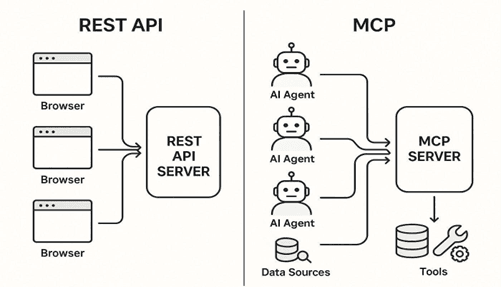
REST exposes resources. MCP exposes capabilities. Instead of a bare POST /notifications, MCP communicates the tool's name, purpose, expected parameters, when it should be used, and its permission requirements — giving AI something APIs were never designed to provide: understanding.
What Exactly Is MCP?
At its core, MCP is an open protocol that standardizes how AI applications communicate with external systems. Instead of every AI platform building unique integrations, organizations expose capabilities through MCP servers, while AI applications — Claude, Cursor, Windsurf, or any other host — connect as MCP clients.
An AI application no longer talks directly to GitHub, PostgreSQL, or Slack — everything flows through MCP, creating a consistent interface regardless of what sits behind it. Three participants make up this architecture:
- MCP Client — the AI application making requests
- MCP Server — exposes capabilities connecting to databases, GitHub, Slack, or internal systems
- External Systems — where the actual business operations happen
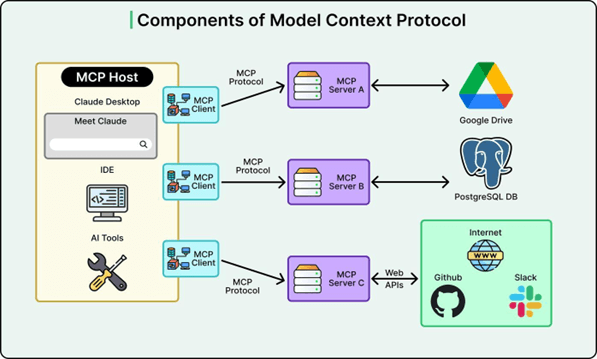
Instead of building separate integrations for every AI application, organizations build one MCP interface that every compatible client can understand — dramatically cutting repeated engineering effort.
How MCP Works Behind the Scenes
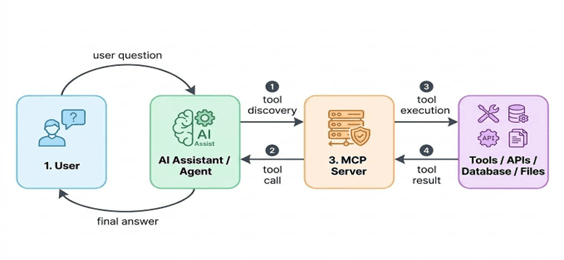
One of MCP's biggest strengths is that AI agents don't need prior knowledge of available tools — everything begins with discovery. Suppose a user asks the AI to create a GitHub issue. The AI first asks the MCP server what capabilities exist, and the server responds with structured metadata:
{
  "name": "create_github_issue",
  "description": "Creates a GitHub issue",
  "parameters": {
    "title": "string",
    "body": "string"
  }
}
The AI didn't memorize GitHub's REST API — it discovered a capability dynamically. Execution then becomes straightforward: the client sends a standardized tool request, and the MCP server handles validation, authorization, execution, and structured responses. From the AI's perspective, GitHub now behaves like any other tool — consistency is one of MCP's greatest strengths.
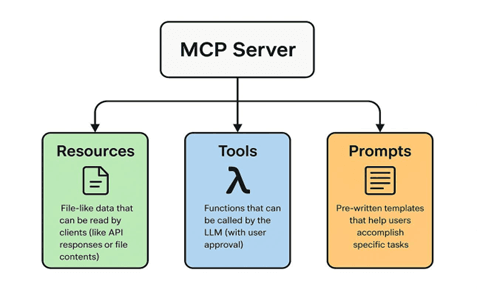
The Three Building Blocks That Make MCP Powerful
1. Tools
Tools perform actions — querying a database, sending emails, creating tickets, or deploying applications:
@mcp.tool()
def search_orders(customer_id: str):
    return query_database(customer_id)
The code itself isn't the innovation — discoverability is. Every compatible AI client automatically understands how to invoke this capability.
2. Resources
Resources provide context rather than actions: documentation, database schemas, configuration files, company policies. Instead of stuffing enormous prompts with background information, the AI requests exactly what it needs — improving accuracy, context efficiency, and maintainability.
3. Prompts
Organizations constantly reuse similar prompts (“generate quarterly reports,” “summarize customer feedback”). Rather than copying these across applications, MCP turns them into reusable, shared workflows — creating organizational consistency without duplicating prompt engineering.
Why Enterprises Are Investing in MCP
Technology standards don't succeed because they're elegant — they succeed because they solve expensive problems. Major technology companies, including OpenAI, Microsoft, AWS, Google Cloud, and Anthropic, have invested in MCP's ecosystem because organizations increasingly want AI that works with existing infrastructure instead of replacing it.
| Traditional Integration | MCP |
|---|---|
| Hundreds of custom connectors | One standardized protocol |
| Different authentication methods | Unified authorization |
| Platform-specific documentation | Automatic capability discovery |
| Duplicate workflows | Shared prompts and tools |
| High maintenance costs | Reusable integrations |
This mirrors earlier shifts: HTTP standardized web communication, OAuth standardized authentication, and MCP is beginning to standardize AI interaction.
The Breakthrough That Made MCP Production-Ready
Early MCP implementations worked well for local development, but enterprise infrastructure introduced a different challenge: stateful connections. Clients were initially tied to specific servers through protocol-level sessions — creating familiar cloud problems like sticky sessions, session storage, and limited horizontal scalability.
The newer MCP specification introduces a major architectural improvement: stateless communication. Every request now carries its own protocol metadata, letting requests flow through ordinary HTTP load balancers without persistent server affinity.
Requests can reach any compatible instance instead of routing back to the same one — enabling horizontal scaling, Kubernetes compatibility, serverless deployment, and improved reliability. For cloud-native systems, this turned MCP from an interesting protocol into practical production infrastructure.
Security: The Real Enterprise Requirement
Performance gets attention. Security gets adopted.
Imagine an AI agent with permission to delete production records, merge pull requests, access payroll, or trigger financial approvals. The challenge isn't intelligence — it's governance. Modern MCP introduces stronger enterprise authorization patterns that integrate with existing identity providers while centralizing permissions, instead of reinventing authentication for every connector.
That shift gives organizations centralized authorization, audit trails, least-privilege enforcement, and consistent permission handling — making MCP especially attractive in regulated industries where compliance matters as much as automation.
A Real Enterprise Workflow
Consider a financial analyst asking: “Show me Q3 revenue growth and generate a Power BI summary.” Without MCP, this typically means querying SQL manually, exporting data, opening Power BI, building visualizations, and writing the summary by hand.
With MCP, the AI discovers the available capabilities itself: it identifies the right SQL tools, executes governed queries, retrieves relevant schemas, sends results into Power BI workflows, and generates the final report — without needing custom Power BI knowledge baked in. That's protocol-driven intelligence in practice.
Why Database Engineers Should Pay Attention
MCP gets especially interesting when databases enter the picture. AI-generated SQL naturally raises concerns, so instead of exposing unrestricted SQL execution, organizations can expose governed business capabilities.
Rather than generating SELECT * FROM customers;, the AI invokes something like find_inactive_customers(days=90).
That small abstraction brings real safeguards: parameter validation, permission enforcement, audit logging, predictable execution, and reduced production risk — a significant improvement for enterprise data platforms.
The Future Belongs to Multi-Agent Systems
Today's AI products increasingly rely on multiple specialized agents — imagine a Planner Agent, a Database Agent, a Developer Agent, and a Reporting Agent all cooperating. Without shared communication standards, coordination becomes fragile, since each agent would need to learn different interfaces.
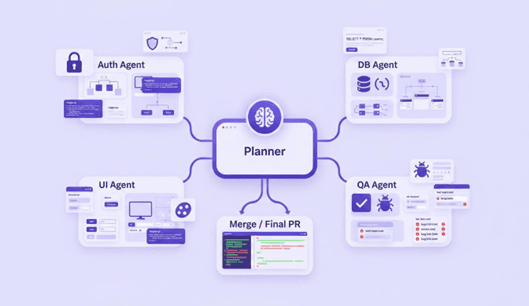
MCP provides shared capability discovery, standardized communication, unified authorization, and consistent governance. As multi-agent architectures become more common, standardized capability exchange only becomes more valuable.
Conclusion
MCP marks a real shift in how AI systems connect to the world: the goal is no longer building one-off integrations for every tool, but exposing capabilities once and letting any compatible AI agent discover and use them safely. By standardizing discovery, execution, and governance, MCP turns integration from a recurring cost into a one-time investment.
As enterprises adopt more LLMs, intelligent document processing, and autonomous agents, MCP's role as the shared communication layer — connecting AI intelligence to real systems without sacrificing security or control — will only grow. The organizations that expose their systems through MCP today will be the ones whose tools AI agents can actually work with tomorrow.